Wilder Landscapes, Cooler Planet: Rewilding for a changing climate
By Gavin Stark, 31 October 2026
Submitted manuscript
Rewilding developed as a conservation approach in the 1990s and aims to restore the natural processes that shape ecosystems, from animal movement to grazing and flooding. These processes already connect biodiversity, climate and people. Climate-smart rewilding builds on this foundation by considering ecological recovery, climate change mitigation, adaptation and local communities’ needs together from the outset. Drawing on the study published in One Earth, this article explains the approach through European landscapes. It shows where benefits might overlap and where fire risk, farming or other local concerns require closer attention. Turning these opportunities into a project requires an agreed plan, committed funding, and people accountable for its decisions. The approach has developed through European research, including the EU-funded Horizon project “wildE”, which began on 1 January 2023 and is coordinated by INRAE in France. Although these examples come from Europe, the questions are relevant to restoration elsewhere.
{1}Why restoring nature involves choices
{2}When farmland is abandoned, grasses and shrubs may establish, followed by trees where conditions allow. This can create wildlife habitat and store carbon in vegetation and soils [1]. In dry landscapes, the growing vegetation can also become fuel for fires [2]. Carbon uptake is the removal of carbon dioxide from the atmosphere as plants grow; carbon storage is the amount held in vegetation and soils [3]. Fast-growing plantations can accumulate carbon quickly because of their species and growing conditions. Planting a single tree species does not itself explain rapid growth or guarantee greater long-term storage, which depends on harvesting and losses from drought, pests, or fire [1, 4, 5]. A global comparison found that native forests generally offered greater aboveground carbon storage and biodiversity benefits than plantations, while plantations produced more wood [5]. Restoration goals can overlap or compete. Keeping meadows open protects their species but limits carbon accumulation in trees; allowing woodland to develop changes which species can live there [1]. Biodiversity and carbon goals can also reinforce each other: a meta-analysis of mainly young planted forests found greater aboveground carbon stocks in mixtures than in the average single-species stand [6]. Outcomes depend on the habitat, species, management and timescale [7, 8].
{3}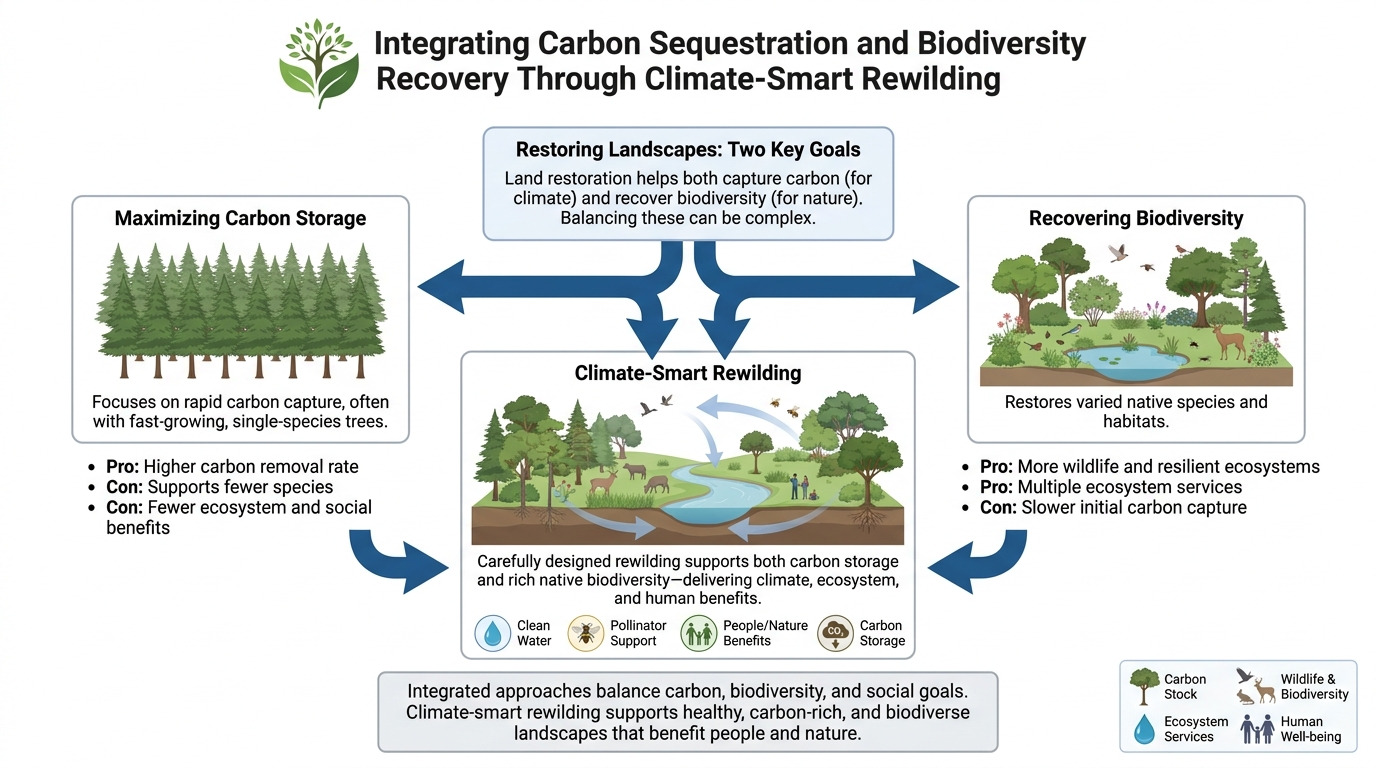
Figure 1. Questions to consider together in climate-smart rewilding. Biodiversity recovery remains the ecological purpose of rewilding. Planning also examines climate mitigation, adaptation, and consequences for local communities. Carbon storage is one part of the assessment. Benefits may overlap, and any trade-offs depend on the place and timescale. The Figure does not imply a necessary trade-off between biodiversity recovery and carbon storage [5, 6]. Based on the framework in [G. Stark et al., 20267].
{4}What makes rewilding climate smart
{5}Rewilding aims to rebuild ecosystems that increasingly sustain themselves. Active work, such as removing barriers or helping native species return, may be needed before repeated intervention can decline [9, 10]. Vegetation can return when pressures ease, but lost species and ecological relationships may not recover, and recovery may lag warming [1, 9, 11]. Where recovery can proceed unaided, protecting and monitoring it may be enough. Comparing these options with what would happen without a project helps establish its contribution [7]. Mitigation means limiting climate change, including by removing atmospheric carbon dioxide and keeping carbon stored in plants and soils [3]. Assessment must consider additional storage and its vulnerability to drought or fire [7, 4]. Adaptation means adjusting to climate change [3]. Connected habitats can help species reach suitable conditions [11, 12], while giving rivers more room can reduce flood risk [13]. Climate-smart planning examines whether these benefits are feasible in a particular place and how they affect people [7, 8].
{6}How natural processes shape a landscape
{7}Three interacting groups of processes, described by Perino and colleagues, provide the ecological foundation of the framework [7, 9]. Dispersal and connectivity concern how organisms move between habitats. Connections can help species track suitable climates, although barriers and movement requirements differ among species [11, 12]. Trophic complexity describes feeding relationships: herbivores eat plants, predators feed on animals, and decomposers break down dead material. Restoring these relationships can change vegetation and nutrient cycling. Grazers can help maintain a mixture of open and wooded habitats [9]. Their feeding may also reduce vegetation that fuels wildfires, depending on the animals, their numbers and food preferences, and local vegetation [2]. Natural disturbances, including floods, storms and fires, create openings and opportunities for growth. Their timing and location are partly unpredictable [9]. Allowing them requires attention to scale and safety: flooding a floodplain has different consequences from flooding a village [13]. Climate change can intensify drought and conditions favouring wildfire, adding to these management choices [3, 4].
{8}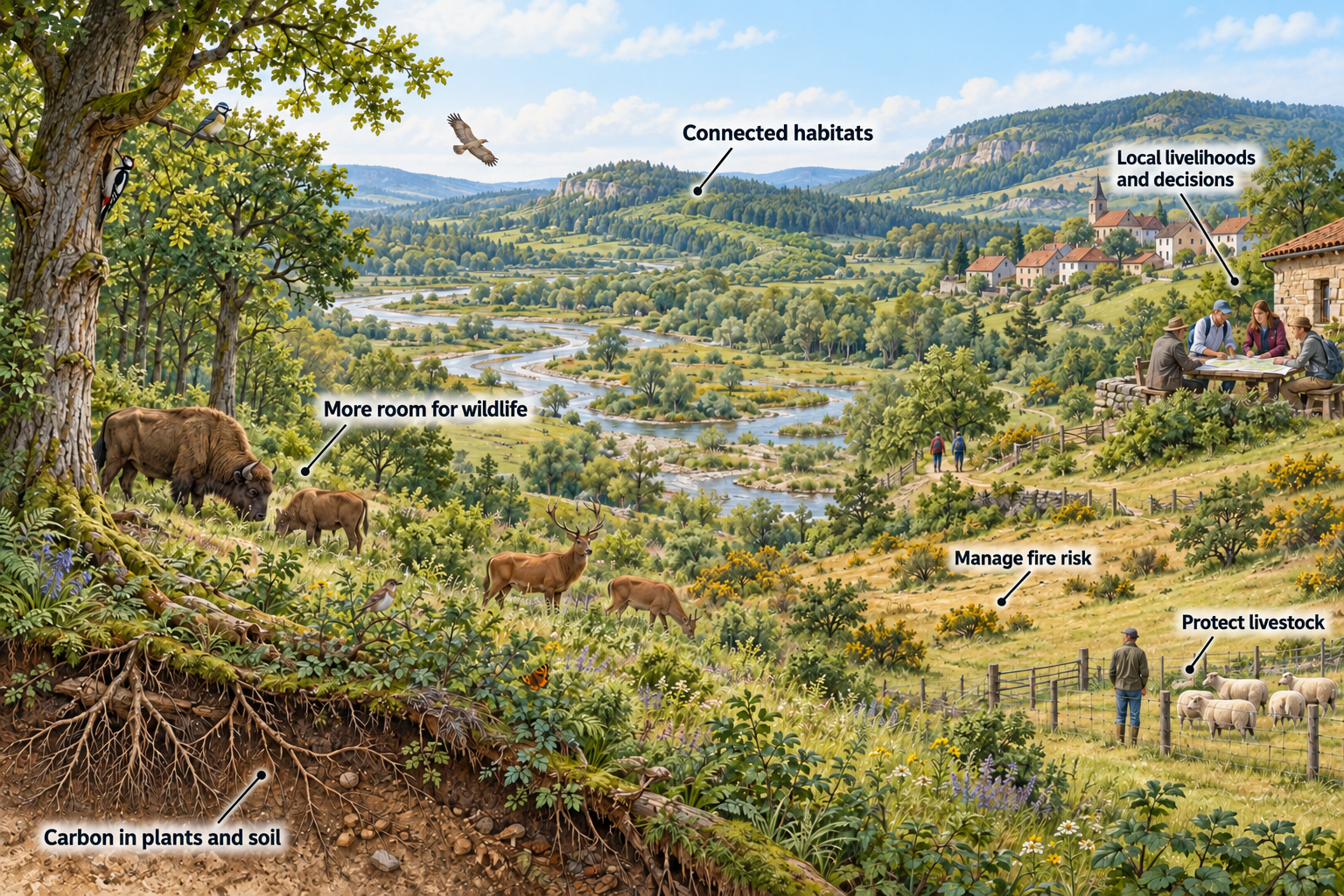
Figure 2. Ecological recovery and local decisions within the same landscape. Connected habitats and returning wildlife can support recovery, while carbon storage, fire risk, livestock protection and livelihoods require joint consideration. The illustration shows issues to discuss and assess, rather than benefits guaranteed at every site. The ecological processes shown are relevant to rewilding generally; the climate-smart framework makes their climate and social implications explicit [7, 9]. AI-generated conceptual illustration.
{9}What the European maps can tell us
{10}Our study combined maps of land use, potential farmland abandonment, connectivity and large mammals with estimates of carbon storage and social opportunities or risks [7]. Carbon-storage opportunities occurred in parts of eastern Europe, the Alps, northern Iberia, western Britain and Ireland. Climate connectivity was particularly relevant in northeastern Europe, where suitable temperature conditions are expected to shift rapidly. Potential wildlife-tourism opportunities were prominent in central and southern Europe, including southern Germany, Austria and northern Italy. Several opportunities overlapped in central and eastern Europe, but fewer areas met all the mapped criteria [7]. Choosing a site for carbon storage alone may therefore overlook difficulties for wildlife or local livelihoods [7]. These patterns indicate potential opportunities and constraints. Tourism estimates represent possible visitor interest rather than guaranteed community income, and the wildlife analyses covered only a limited set of large mammals. Local assessment of other species, land use and people’s priorities remains essential [7, 8, 10].
{11}Climate-smart rewilding in four landscapes
{12}Four European landscapes illustrate different management strategies. Near Barcelona, Collserola Natural Park combines regeneration and biodiversity conservation with targeted vegetation management beside paths and housing. Removing too much vegetation can make conditions drier and favour more flammable plants, so fire prevention requires careful choices about where and how to intervene [2, 14]. Sweden’s Sveaskog Ecoparks combine conservation and restoration with forestry elsewhere in the landscape. Wetland restoration, controlled burning and measures favouring deciduous trees raise questions about where intervention helps and where recovery can proceed with less management [15]. Assessment must distinguish the effects of restoration from those of ongoing forestry. After the 2004 windstorm in the Slovak Tatra Mountains, unlogged plots retained more deadwood, more varied vegetation and more natural spruce regeneration than plots where fallen trees were removed [16]. This shows how decisions after disturbance influence recovery. At Gelderse Poort in the Netherlands, grazing cattle and horses shape a varied floodplain used for recreation. Reconnected channels link recovery with flood management, supported by local involvement and agreements about land use and funding [13, 17].
{13}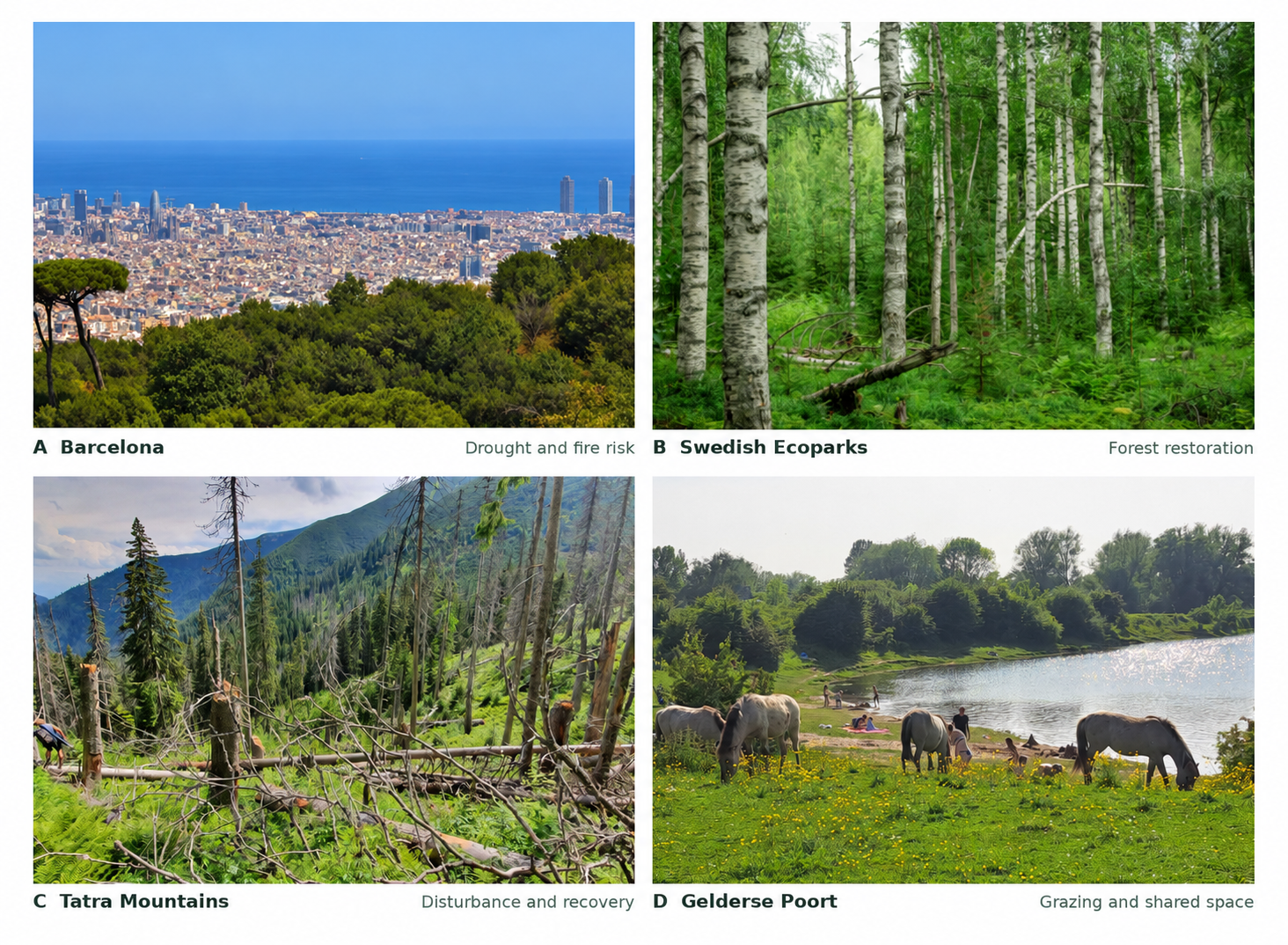
Figure 3. Four European landscapes illustrating different restoration questions. A, Barcelona: forest recovery beside a city brings attention to fire prevention [14]. B, Swedish Ecoparks: conservation and restoration alongside forestry [15]. C, Tatra Mountains: disturbance and natural recovery [16]. D, Gelderse Poort: grazing, wildlife, recreation and room for the river [17]. The photographs provide examples of case studies from the wildE project using climate-smart interventions. Photograph credits: (A) Josep M. Espelta; (B) Lydwin Wagenaar and Henrik Smith; (C) Karol Kaliský; and (D) Nacho Villar. All photographs are used with permission for this article.
{14}Living alongside returning wildlife
{15}Returning large animals may bring visitors and income to wildlife-watching businesses while imposing costs on livestock farmers [1, 7, 18]. Tourism income does not automatically reach those bearing these costs. Our maps examined where wolves and bears could expand into livestock areas, helping identify where conflict prevention may be needed [7]. Fencing and livestock-guarding dogs are possible measures, but their suitability and effectiveness need local assessment and monitoring [18]. Local knowledge can clarify how land is used and which changes people are willing and able to accommodate. Those affected should help decide how benefits, costs and responsibilities are shared [8, 10].
{16}Who starts the work and who pays
{17}A landowner, community organisation, conservation group or public authority may initiate a project, depending on who has the rights and capacity to act. The motive might be recurring flood damage, changing farm income, or a restoration duty. Partners should agree on its aims, name a responsible organisation and project lead, and involve landholders and affected communities in decisions. People should know whom to contact if problems arise [7, 10]. A feasibility assessment should check land rights, local priorities and climate risks, comparing natural recovery with more active options. The preferred option needs a dated, costed plan covering agreements and permissions, implementation and reviews. Each stage requires a responsible person, budget and decision date, with provision for recovery that extends beyond an initial grant [10, 19]. Funding might combine public budgets, charitable grants and landowner or business contributions. It must cover consultation, land access, works, monitoring, ongoing management, contingencies and agreed compensation. Partners should specify who pays and who remains responsible when initial funding ends. Possible tourism or carbon income should not be treated as secured funds [7, 8, 19]. Wider economic benefits need similar care. Nepal and colleagues projected that forest protection could improve global forestry-sector returns through timber-price changes, while also projecting income losses in some countries [20]. Such projections cannot replace a local funding plan or an assessment of who gains and loses.
{18}Making choices as conditions change
{19}Projects need measures of success covering species recovery, connectivity, carbon storage and effects on people [7, 21]. Monitoring should also track spending, livestock losses and who receives new income. Where feasible, funders can support tests that compare management options and pay for analysing and sharing the results [19]. Monitoring change alone cannot establish how much the project caused, because the landscape would also change without it. Plans must account for future drought, fire, flooding and, on coasts, sea-level rise [3, 4]. Will woodland have enough water to recover? Can coastal habitats move inland [3, 8]? Agreed dates for reviewing the changes in a rewilded ecosystem, such as repeated regeneration failure or unacceptable impacts on neighbours, should guide revisions. The responsible organisation needs authority and funds to change, pause or stop an action [7, 10]. Climate-smart rewilding depends on learning from what happens and adjusting decisions with the people affected.
| [1] | L.M. Navarro and H.M. Pereira: Rewilding abandoned landscapes in Europe, Ecosystems, vol. 15, 900-912, https://doi.org/10.1007/s10021-012-9558-7, 2012. |
| [2] | J. Rouet-Leduc, G. Pe’er, F. Moreira, A. Bonn, W. Helmer, S.A.A. Shahsavan Zadeh, A. Zizka and F. van der Plas: Effects of large herbivores on fire regimes and wildfire mitigation, Journal of Applied Ecology, vol. 58(12), 2690-2702, https://doi.org/10.1111/1365-2664.13972, 2021. |
| [3] | IPCC: Climate Change 2023: Synthesis Report. Contribution of Working Groups I, II and III to the Sixth Assessment Report of the Intergovernmental Panel on Climate Change, Writing Team Core, H. Lee and J. Romero (Eds.). IPCC, Geneva, Switzerland, 184 pp., https://doi.org/10.59327/IPCC/AR6-9789291691647, 2023. |
| [4] | W.R.L. Anderegg, A.T. Trugman, G. Badgley, C.M. Anderson, A. Bartuska, P. Ciais, D. Cullenward, C.B. Field, J. Freeman, S.J. Goetz and co-authors: Climate-driven risks to the climate mitigation potential of forests, Science, vol. 368(6497), eaaz7005, https://doi.org/10.1126/science.aaz7005, 2020. |
| [5] | F. Hua, L.A. Bruijnzeel, P. Meli, P.A. Martin, J. Zhang, S. Nakagawa, X. Miao, W. Wang, C. McEvoy, J.L. Peña-Arancibia and co-authors: The biodiversity and ecosystem service contributions and trade-offs of forest restoration approaches, Science, vol. 376(6595), 839-844, https://doi.org/10.1126/science.abl4649, 2022. |
| [6] | E. Warner, S.C. Cook-Patton, O.T. Lewis, N. Brown, J. Koricheva, N. Eisenhauer, O. Ferlian, D. Gravel, J.S. Hall, H. Jactel and co-authors: Young mixed planted forests store more carbon than monocultures—a meta-analysis, Frontiers in Forests and Global Change, vol. 6, 1226514, https://doi.org/10.3389/ffgc.2023.1226514, 2023. |
| [7] | G. Stark, M. Weissgerber, N. Fernández, L.C. Quintero-Uribe, M. Giergiczny, N.R. Poulsen, N. Villar, B. Mols, E.S. Bakker, A.M. Smith, G. Winkel, D. Alagador, J.M. Rey-Benayas, J.M. Espelta, M. Selwyn, L. Brotons, T. Kluvankova, S. Brnkalakova, J. Kloibhofer, R. Prestele, H.G. Smith, A. Lázaro-González, R. Buitenwerf, E.A. Pearce, J.-C. Svenning, J. Santana, P. Beja, F. Moreira, S. Wunder, M. Svoboda, V. Vancura, A. Arneth, A. Hampe and H.M. Pereira: Toward climate-smart rewilding: An integrated framework for biodiversity, climate change, and society, One Earth, vol. 9(6), https://doi.org/10.1016/j.oneear.2026.101704, 2026. |
| [8] | N. Seddon, A. Chausson, P. Berry, C.A.J. Girardin, A. Smith and B. Turner: Understanding the value and limits of nature-based solutions to climate change and other global challenges, Philosophical Transactions of the Royal Society B: Biological Sciences, vol. 375(1794), 20190120, https://doi.org/10.1098/rstb.2019.0120, 2020. |
| [9] | A. Perino, H.M. Pereira, L.M. Navarro, N. Fernández, J.M. Bullock, S. Ceaușu, A. Cortés-Avizanda, R. van Klink, T. Kuemmerle, A. Lomba and co-authors: Rewilding complex ecosystems, Science, vol. 364(6438), eaav5570, https://doi.org/10.1126/science.aav5570, 2019. |
| [10] | S. Carver, I. Convery, S. Hawkins, R. Beyers, A. Eagle, Z. Kun, E. Van Maanen, Y. Cao, M. Fisher, S.R. Edwards and co-authors: Guiding principles for rewilding, Conservation Biology, vol. 35(6), 1882-1893, https://doi.org/10.1111/cobi.13730, 2021. |
| [11] | C. Carroll and R.F. Noss: Rewilding in the face of climate change, Conservation Biology, vol. 35(1), 155-167, https://doi.org/10.1111/cobi.13531, 2021. |
| [12] | G. Stark, J. Dertien, N.R. Poulsen, E. Berti, A.C. Mármol Guijarro, M. Weissgerber, N. Fernández and H.M. Pereira: Energetic Constraints Reshape Climate‐Tracking Opportunities for Large Mammals Across European Protected Area Networks, Conservation Letters, vol. 19(5), e70094, https://doi.org/10.1111/con4.70094, 2026. |
| [13] | F. Klijn, N. Asselman and D. Wagenaar: Room for rivers: Risk reduction by enhancing the flood conveyance capacity of The Netherlands’ large rivers, Geosciences, vol. 8(6), 224, https://doi.org/10.3390/geosciences8060224, 2018. |
| [14] | Forest management. Parc Natural de la Serra de Collserola. Retrieved (16 October 2026) from https://parcnaturalcollserola.cat/en/forest-management/. |
| [15] | Our ecoparks — forest landscapes with plenty of space. Sveaskog. Retrieved (16 October 2026) from https://www.sveaskog.se/en/vart-skogsbruk/skog-med-hoga-naturvarden/our-ecoparks/. |
| [16] | Z. Michalová, R.C. Morrissey, T. Wohlgemuth, R. Bače, P. Fleischer and M. Svoboda: Salvage-logging after windstorm leads to structural and functional homogenization of understory layer and delayed spruce tree recovery in Tatra Mts., Slovakia, Forests, vol. 8(3), 88, https://doi.org/10.3390/f8030088, 2017. |
| [17] | Kruiff T. de, C. Fraccaroli, N. Villar, J. Slagt, R. van de Port and E.S. Bakker: Interdisciplinary insights on climate-smart rewilding: Lessons from pioneering Dutch river transformations, Ambio, https://doi.org/10.1007/s13280-026-02451-6, 2026. |
| [18] | Eeden L.M. van, M.S. Crowther, C.R. Dickman, D.W. Macdonald, W.J. Ripple, E.G. Ritchie and T.M. Newsome: Managing conflict between large carnivores and livestock, Conservation Biology, vol. 32(1), 26-34, https://doi.org/10.1111/cobi.12959, 2018. |
| [19] | R.K. Smith, N. Ockendon, N. Al-Fulaij, A. Badalotti, R. Beattie, J. Byrne, S. Cooke, T. de Zoeten, W.F. Frick, S.M. Funk and co-authors: Role of funders in embedding tests in conservation practice, Conservation Biology, vol. 40(5), e70309, https://doi.org/10.1111/cobi.70309, 2026. |
| [20] | P. Nepal, A. Waldron, J.P. Prestemon, T. Gopalakrishna and M. Jung: Economic costs of global forest protection may be overstated, Nature Communications, vol. 17, 6649, https://doi.org/10.1038/s41467-026-73569-0, 2026. |
| [21] | A. Torres, N. Fernández, S. zu Ermgassen, W. Helmer, E. Revilla, D. Saavedra, A. Perino, A. Mimet, J.M. Rey-Benayas, N. Selva and co-authors: Measuring rewilding progress, Philosophical Transactions of the Royal Society B: Biological Sciences, vol. 373(1761), 20170433, https://doi.org/10.1098/rstb.2017.0433, 2018. |

